TL;DR
Saner AI organizes your knowledge, emails, and tasks between meetings. Evro AI improves your communication inside them. They are complementary tools — not competitors. Most neurodivergent professionals in meeting-heavy environments will eventually benefit from both.
Saner AI and Evro AI solve different problems for neurodivergent professionals. Saner AI is a personal knowledge management and task organization tool — it helps you capture thoughts, manage emails, organize notes, and plan your day between meetings. Evro, a communication intelligence platform, helps you perform better inside meetings through real-time guidance, post-meeting feedback, and relationship intelligence grounded in clinical psychology research. These are complementary tools, not competitors. Understanding which problem each one solves — and when — is the first step to building a complete support stack for neurodivergent professionals in meeting-heavy work environments.
Key Concepts in This Comparison
Communication intelligence (noun, Evro): A category of AI tooling focused on improving how professionals communicate in real-time conversations — not by transcribing or documenting what was said, but by analyzing communication patterns, surfacing behavioral feedback, and providing in-the-moment guidance grounded in psychology research. Distinct from productivity tools, note-taking apps, or transcription services.
Relational context (noun, Evro): The accumulated, data-driven understanding of how a specific person communicates, what they care about, and how a working relationship is developing over time. Relational context is built automatically from meeting data and used to inform how you prepare for and navigate future conversations with that person.
The intent-impact gap (noun, Evro): The measurable distance between what a communicator intends to convey and what the other person actually receives. This gap is especially prevalent in neurodivergent communication styles — not because of a deficit in the communicator, but because most professional environments lack structured feedback mechanisms to surface and close it.
Executive function (noun, general): The set of cognitive processes — working memory, cognitive flexibility, planning, and impulse control — that govern how people organize information, initiate tasks, and manage time. Executive function demands are significantly elevated in meeting-heavy work environments, and tools that reduce executive function load are of disproportionate value to neurodivergent professionals.
What Is Saner AI?
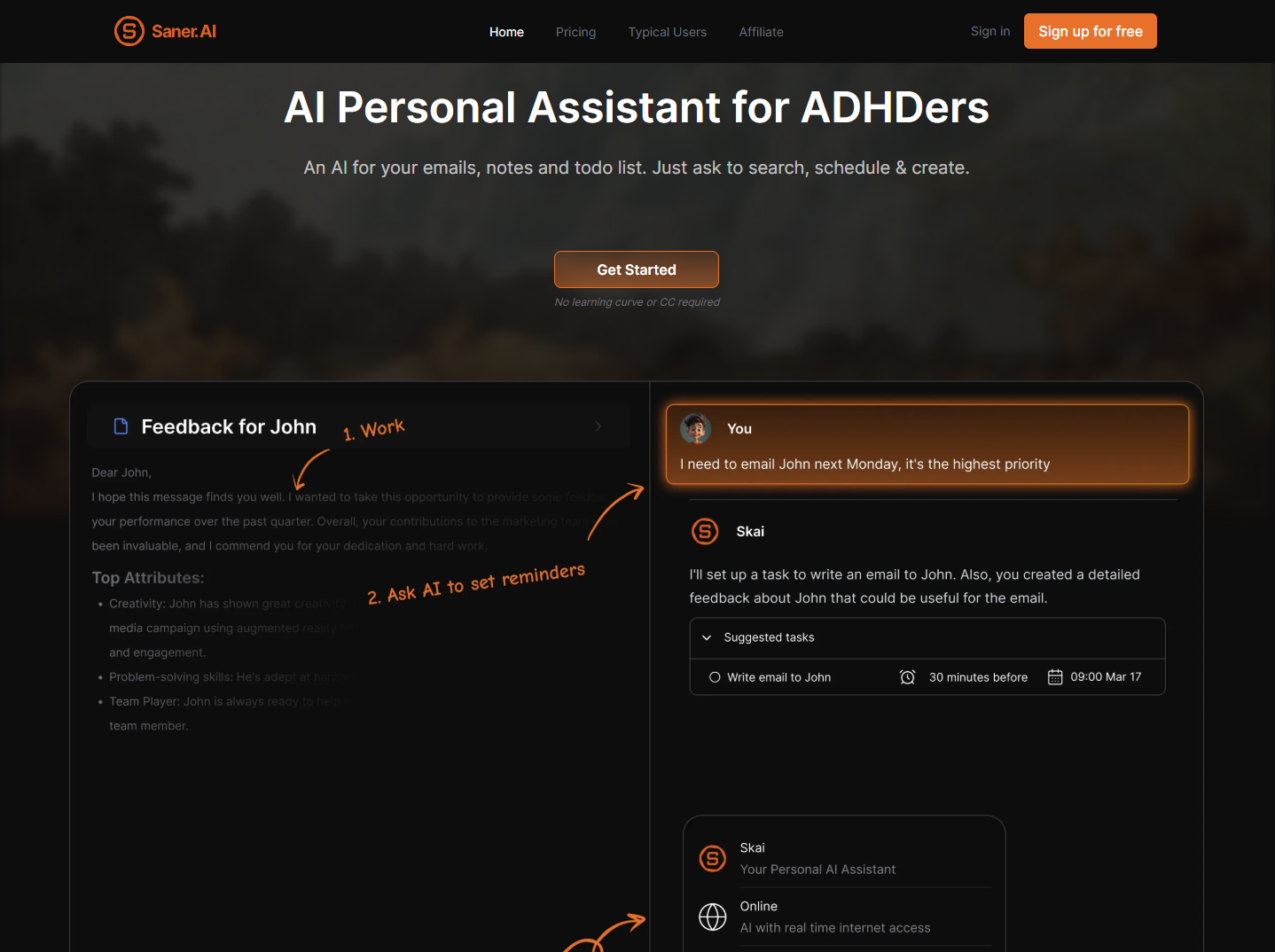
Saner AI (saner.ai) is a personal AI assistant and knowledge management platform built explicitly for neurodivergent professionals, particularly those with ADHD. Its core product is a unified workspace that brings together notes, email, tasks, and calendar into a single interface, and applies AI — primarily through its personal assistant "Skai" (Sidekick AI) — to organize, synthesize, and surface information without requiring manual effort from the user.
The central problem Saner AI is designed to address is information fragmentation: the experience of having relevant context scattered across different apps, inboxes, and notes in ways that make it cognitively expensive to retrieve when needed. For professionals with ADHD or other neurodivergent profiles, this fragmentation is not merely inconvenient — it represents a significant executive function tax that accumulates across every workday.
Saner AI's key features include:
- Skai (Sidekick AI): A personal AI that learns from the user's notes and automatically organizes, tags, and categorizes information without manual input. Users can ask Skai to summarize a topic they've been tracking, parse a brain dump into a structured task list, or retrieve context from a specific time period.
- Proactive daily planning: Skai reviews the user's emails, notes, tasks, and calendar and provides a prioritized daily plan each morning, along with proactive check-ins throughout the day — directly supporting time awareness, a known challenge for individuals with ADHD-related time blindness.
- Brain dump to task conversion: Users can capture unstructured thoughts via voice note, typed brain dump, or Chrome extension, and Skai will automatically extract tasks, reminders, and action items from that raw input.
- Semantic search: Natural-language search across notes, emails, and documents — meaning users can find information without remembering exact keywords, file locations, or when something was saved.
- Integrations: Gmail, Google Drive, Google Calendar, Slack, Chrome browser, iOS and Android.
- Pricing: Free plan available. Paid plans start at approximately $8/month (Starter, billed annually) and $16/month (Standard, billed annually).
What Saner AI Does Not Do
Saner AI does not join, record, or analyze meetings. It has no awareness of what happens inside a Zoom, Teams, or Google Meet conversation. It cannot tell you how you came across in a discussion, what the tone of the room was, or whether a key message landed the way you intended. It is a tool for managing knowledge and tasks between meetings — not a tool for improving performance within them.
This distinction is not a criticism. It is a precise description of the tool's scope, and it matters for understanding where each product fits in a neurodivergent professional's workflow.
What Is Evro AI?
Evro AI (evro.ai) is a communication intelligence platform designed to help professionals perform better inside meetings — in real time and over time. Where Saner AI focuses on the knowledge management layer that surrounds meetings, Evro focuses on the conversation itself: how the user communicates, how that communication lands with others, and how communication patterns develop and improve across time.
Evro is built on a psychology-first design framework. Every feature is developed around how people actually think, misread, and improve in real interpersonal environments — drawing on established research in cognitive load theory, deliberate practice, Gottman relationship research, and evidence-based communication frameworks. Transcription and meeting summaries are the entry point; the product is the coaching and intelligence layer built on top of that data.
Evro's capabilities span three moments in every professional's meeting lifecycle:
- Before the meeting: Auto Meeting Prep compiles recent interaction history, open action items, and relational context into a concise pre-meeting brief — automatically, without manual data entry.
- During the meeting: Real-Time Meeting Guidance provides optional, private prompts during live conversations based on the user's defined communication goals. These cues are never visible to other participants.
- After the meeting: Meeting Insights delivers a structured post-meeting debrief — what went well, how the user came across, the dynamics in the room, and specific grounded feedback on communication patterns.
The Core Difference: Between the Meeting vs. Inside It
The most precise way to distinguish these two tools is by where their value is delivered.
| Saner AI | Evro AI | |
|---|---|---|
| Primary use | Knowledge & task management | Communication intelligence |
| When it works | Between meetings | During & after meetings |
| Joins meetings? | No | Yes — records & analyzes |
| Real-time guidance? | No | Yes — private, in-meeting nudges |
| Post-meeting feedback? | No | Yes — Meeting Insights & About Me |
| ADHD-specific design? | Yes — core positioning | Yes — communication anxiety focus |
| Starting price | Free / ~$8/month | See evro.ai for current pricing |
Neither tool can substitute for the other. A professional who enters a meeting with perfectly organized notes but no real-time communication support is still navigating the live conversation alone. A professional who receives precise post-meeting feedback but can't retain or act on context between sessions loses much of the compounding value that communication intelligence can build over time.
Where Neurodivergent Professionals Actually Struggle
To understand why both tools matter, it helps to look precisely at where meeting-heavy work creates friction for neurodivergent professionals — because the friction is not uniform, and different tools address different pressure points.
Before the meeting: cognitive preparation
63% of workers want context from previous meetings automatically available when they begin their next one — not buried in transcript archives.
For neurodivergent professionals, the preparation gap is compounded: they may have the context somewhere, but retrieving, organizing, and synthesizing it in the limited time between back-to-back meetings requires working memory capacity and executive function that is already under strain. The result is entering meetings underprepared — not because of lack of effort, but because the retrieval system wasn't built for how they process and store information.
During the meeting: cognitive overload and social monitoring
72% of professionals report information overload from meetings. 68% report frequent anxiety, confusion, or fatigue during meetings.
Cognitive load research (Sweller) demonstrates that simultaneously processing meeting content — following arguments, tracking decisions, forming responses — and monitoring social dynamics — reading tone, timing contributions, managing relational risk — degrades performance on both tasks. For neurodivergent professionals, this dual-task demand is particularly acute. The internal monitoring load — "did that land right?", "should I speak now?", "was that too blunt?" — is a known executive function cost that consumes working memory and competes directly with the ability to think clearly.
After the meeting: rumination and the absence of feedback
Neurodivergent-leaning professionals spend an estimated 5.2 hours per week on "communication recovery" — replaying conversations, processing social ambiguity, and managing uncertainty about how interactions landed.
When meetings end without clear, structured feedback, the cognitive work doesn't stop. This time and cognitive energy is unavailable for actual work, and it compounds across a meeting-heavy week. The core problem is not that neurodivergent professionals are more prone to rumination — it is that without access to grounded feedback, there is no mechanism to close the loop and move on.
The relational layer: stakeholder navigation
Neurodivergent professionals who manage multiple stakeholders also face a distinct challenge: the communication preferences, interaction history, and relational dynamics of every working relationship exist in their head, imperfectly retained and inconsistently applied. CRMs track deals. Calendars track appointments. Nothing tracks the human dynamics underneath them — until tools are specifically designed to do so.
How Saner AI Helps Neurodivergent Professionals
Saner AI's contribution to the neurodivergent professional's workflow is most valuable in three areas.
Reducing the executive function cost of information retrieval. By automatically organizing notes, emails, and tasks using AI — without requiring manual categorization or filing — Saner AI reduces the retrieval tax that makes context-switching so costly for professionals with ADHD or working memory challenges. Skai's semantic search means that relevant information can be surfaced through natural language rather than exact-match recall, which aligns well with associative rather than sequential memory patterns.
Converting cognitive overload into structured priorities. The brain dump to task conversion feature directly addresses one of the most common executive function barriers for ADHD: the gap between having ideas and being able to act on them. When unstructured thoughts can be captured quickly and converted automatically into actionable tasks, the energy cost of planning and task initiation drops significantly.
Proactive structure for time awareness. Saner AI's daily planning feature — which reviews calendar, tasks, and email and provides a morning plan alongside periodic check-ins — offers exogenous structure that supports time awareness without requiring the user to generate that structure independently.
Where Saner AI is less effective is in any moment that requires awareness of live conversation. It has no insight into what happens when the Zoom call starts.
How Evro Approaches This
Evro AI is built specifically for the moments that Saner AI cannot reach: the live conversation, the communication performance, and the feedback loop that follows. For neurodivergent professionals, Evro addresses the meeting experience at five distinct levels.
1. Private, real-time guidance during live conversations. Real-Time Meeting Guidance provides optional, private prompts based on the user's defined communication goals — delivered only to them, never visible to other participants. For professionals who expend significant cognitive energy monitoring their own communication in real time, this creates a supported layer of in-the-moment awareness that reduces the internal monitoring load rather than adding to it.
2. Post-meeting feedback that replaces rumination with resolution. Meeting Insights delivers a structured debrief after every meeting: a Meeting Debrief covering what went well, a "How Did I Do?" section with grounded feedback, Room Dynamics that surfaces tone and hidden cues, and Stakeholder Insights. For neurodivergent professionals who would otherwise spend hours processing ambiguity from a single call, this converts an open loop into a closed one.
3. A continuously updated picture of communication patterns. About Me builds a longitudinal self-profile from actual meeting data — identifying communication strengths, blind spots, tone tendencies, and how style shifts across different contexts. The Monthly Wins Report surfaces evidence of progress against negativity bias — a structurally important counterbalance for neurodivergent professionals whose self-assessments are often harsher than reality.
4. Relationship intelligence for complex stakeholder environments. About Others tracks communication preferences, interaction history, and relational dynamics for every person the user works with regularly. When used alongside Auto Meeting Prep, this creates a system where every conversation builds on the full relational context of the relationship — not just what the user can hold in working memory.
5. A private space to prepare for high-stakes conversations. Role Plays allow users to practice difficult or anxiety-inducing conversations with an AI sparring partner before they happen — receiving structured coaching on how to frame a message, manage their tone, and anticipate responses.
Why Neurodivergent Professionals Often Need Both
The case for using Saner AI and Evro AI together rests on a simple observation: the neurodivergent professional's meeting challenge has three distinct phases, and the two tools address different phases without overlap.
Saner AI addresses the between-meeting environment: organizing knowledge, managing tasks, synthesizing context, and creating structure in the hours that surround meetings. It is particularly well-suited to executive function challenges related to information management and task initiation.
Evro AI addresses the meeting environment itself: what happens when the camera is on, what feedback emerges after the call ends, and how communication patterns develop over time. It is particularly well-suited to the social and communicative demands of live conversation — the layer that no amount of pre-meeting note organization can fully prepare you for.
The professional who uses only Saner AI walks into meetings better prepared — but is still navigating the live dynamics without real-time support or structured feedback afterward. The professional who uses only Evro AI receives rich communication intelligence from every meeting — but may struggle to retrieve context, organize follow-ups, and prepare effectively between sessions without a structured knowledge system.
Together, they create what might be called a full-cycle meeting support stack: one tool that manages the information environment around meetings, and one that develops the communication capability inside them.
54% of professionals hesitate to speak up in meetings due to fear of being misunderstood. 46% struggle to know when to contribute without disrupting the flow. These are not personal limitations — they are the predictable output of environments that offer no structured support for the communicative demands they create.
Frequently Asked Questions
Does Saner AI work with meeting recordings or transcripts?
No. Saner AI is a personal knowledge management tool that works with notes, emails, tasks, and calendar data. It does not join, record, or process meeting conversations. If you're looking for AI support specifically for what happens inside meetings — real-time guidance, post-meeting feedback, communication pattern analysis — that falls outside Saner AI's scope.
Can Evro AI help me organize my notes and tasks between meetings?
Evro's primary focus is communication intelligence inside meetings: real-time guidance, post-meeting feedback, relational context, and communication coaching. Evro does surface action items from meetings and maintains a Task Manager to consolidate commitments across conversations. However, Evro is not a general knowledge management or personal productivity tool. For comprehensive note organization, email management, and daily task planning, Saner AI serves that function well.
Which tool should I start with if I'm neurodivergent and struggling in meetings?
This depends on where your friction is most acute. If you're finding meetings cognitively overwhelming in the moment — struggling to contribute, worried about how you come across, or spending hours processing conversations afterward — Evro AI addresses those specific experiences directly. If your primary challenge is entering meetings underprepared because your information environment is fragmented and disorganized, Saner AI targets that problem. Many professionals will eventually benefit from both.
Is Evro AI only useful for people with diagnosed neurodivergent conditions?
No. Evro is designed for any professional for whom meetings are cognitively demanding and communication improvement is a genuine priority — whether that's because of a neurodivergent profile, high meeting volume, complex stakeholder environments, or a desire to develop communication skills more systematically. Neurodivergent professionals often experience these challenges more intensely, but they are not exclusive to any diagnostic category.
Does Evro AI share my communication data with my employer or manager?
No. All communication feedback, self-profile data, and coaching insights in Evro are private to the individual user. No data is shared with managers, teams, or employers. This is a design principle, not a setting — Evro is built as a personal intelligence tool, not a surveillance or performance management system.
Try Evro AI
If the friction you experience in meetings is the kind that better note organization can't solve — the moments of uncertainty during live conversation, the hours spent replaying what happened, the working relationships where something feels slightly off but you can't pinpoint it — Evro AI was designed for exactly those moments. Try it with your next meeting and see what you've been unable to see before.
Subscribe to our newsletter
Stay up to date on our product updates,
latest news, upcoming events and more.